
The retroNUC project comes from a stupidly ambitious idea:
“How many playable video games can you fit onto a single device?”
I’d been trying for six months or so to set up an emulation project using a Raspberry Pi 4B and RetroPie, and it was working okay, but I kept running across lots of minor issues. In addition, the device wasn’t struggling to run some later 3D-based consoles like the GameCube, which is where a lot of my nostagia lies.
Instead of upgrading to a slightly more expensive 64-bit single-board computer like the ODROID, I decided to throw common sense out the window when I saw the release of Intel’s new 11th Generation NUC devices…
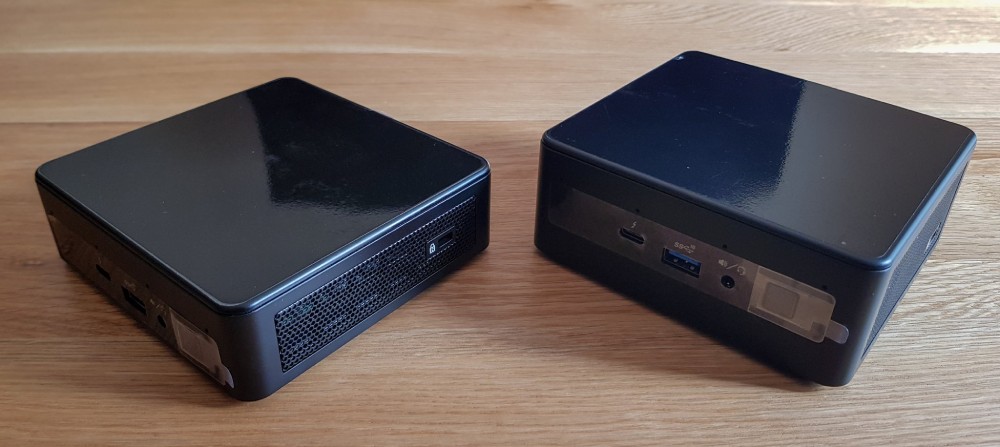
Aren’t they cute? And with enough horsepower to run anything I throw at them at 4K, I think it’s possible to make the perfect emulation box. Screw the cost. And I might as well share my journey with everyone else.
Project Goals
- Curate a library with full playable collections for all controller-based home consoles
- Everything configured as seamlessly as possible with a single device - Pick up a controller, select a game, and start playing straight away
- Use the 1G1R (‘One game, one ROM’) princible to cut collections down from archive-quality complete sets to reasonable browsable/playable collections
- Potential expansion into arcade and home computer collections, but I don’t want to attach anything more than a controller
- Achieve the best realistic experience available on modern hardware
- A focus on accurate emulators and cores, outputting at the original resolution of the console with no additional enchancements (anti-aliasing, internal resolution boosts, etc.)
- Use RetroArch’s overlay/shader systems where appropiate to emulate the look of CRT/LCD screens at a 4K resolution, without needing to invest in expensive older technology
- Present games in a user-friendly way that preserves the history
- A custom artbook-style frontend theme, showing off gameplay images/videos alongside production details
- An accurate database of information such as developers, publishers and release dates, compiled from various sources
- Contribute back to video game emulation and preservation resources
- Capture/gather screenshots and video clips where existing resources don’t meet my own quality standards, and upload these to catalog sites
- Use my coding and development experience to test and report issues, as well as submit bug fixes or feature improvements to open-source software
- Develop my own skills
- Familiarity with Linux-based systems (which I’ve never used before)
- Web development, markdown, and getting back into blogging
- Image and video editing skills, and maybe even some livestreaming